Odd numbers are normal: a murder mystery for 7 players needs no workaround
Hosts with seven guests tend to arrive at the kit page already apologizing, as if the number were a flaw to be fixed. It is not. Every one of the seven kits is written for 6 to 12 players, and the host guide is built for every count in that range, odd or even. Seven is simply the middle of the first tier.
The mechanism is the same at every count. The host guide lists a core cast of six roles that are always handed out, then names which roles join at eight, at ten and at twelve. The murderer and the key witness are always among the roles in play. Any role not handed out stays in the story as a guest, and the host answers briefly for that character if a clue mentions them.
So seven means the core six plus one of the two roles that join at eight. That is the whole workaround, and it is written into the file you download. Nothing to double up, nobody playing two characters, no guest sitting out as an observer. The printable murder mystery kit page explains how the tiers are built if you want the wider picture first.
Which tier to buy and what it costs at seven
Kits are sold by tier: $39 for 6 to 8 players, $49 for 9 to 10, $59 for 11 to 12. Seven sits inside the first tier, so you buy the 6 to 8 version at $39, which works out to about $5.60 a head. One purchase covers the whole group; there is no per-player charge and no separate file for seven.
You choose the tier at checkout and the PDF is generated for it, then emailed within seconds of paying by card. Nothing is shipped. The file contains everything the tier needs: the host guide, eight character sheets, the clues sorted by round, the secret ballots and the solution. At seven you print seven of the eight sheets, and the eighth stays in the file for the day you need it.
All seven scenarios on the murder mystery kits page follow the same tier structure, so the choice at seven is about setting and run time, not about which kit can handle the count. Every one of them can.
How the host guide handles the seventh player
Open the host guide to the section on adapting the game to your number of players. It names the two roles that join at eight. At seven you hand out one of them and leave the other in the story. There is no wrong answer: the murderer and the key witness are in the core six, so neither added role changes the solution.
Choose by your guests rather than by the plot. Read both added sheets before deciding; it takes five minutes. Give the one with more to hide to the guest who will enjoy being questioned. If your seventh guest is shy, pick the added role whose information is concrete and easy to deliver, and leave the other in the story.
The role you leave out does not vanish. It is present in the setting as a guest, and if a clue in round two mentions where that character was, the host answers for them in one sentence, using what the guide says. Prepare that sentence the day before. Players rarely ask twice.
Why an odd number helps the conversation
Even counts settle into pairs. Eight players in round one become four conversations of two, and they stay that way until the host breaks them up. Seven cannot do that. Someone is always the odd one out of a pairing, and that person walks over to another conversation and turns it into three. The groups reshuffle by themselves.
That floating suspect is the best thing about seven. Whoever is momentarily unpaired becomes the person everyone gets a turn to question, and by the end of a round the floater has changed four or five times. Information moves around the room faster than at eight, and the host does less pairing and more listening.
It also means the ballot is livelier. With seven, there is no comfortable pair who spent the whole night together and vote for the same person out of loyalty. Expect the votes to spread. The host can help this along with one instruction at the start of each round: talk to someone you have not talked to yet.
Seating a table of seven
Seven at one table is easy to seat badly. A rectangular dining table seats three on each side and one at each end, which leaves an end seat isolated and the two middle seats doing all the talking. Put the host in one end seat, with the guide and the envelopes, and seat the seven players three and three down the sides plus one at the far end facing the host. The far end is a good seat for a talkative guest; they can reach everyone.
A round table is better if you have one. Seven around a circle, with the host on a stool just outside it, gives every player a clear line to every other player, which is what a small cast needs.
For the rounds themselves, do not stay seated. Read the introduction at the table, then send people to their feet for the questioning, and bring them back to the table for the clues between rounds and for the ballot. Standing rounds are where the odd-number reshuffling happens; a seated round of seven turns into six people talking across one person.
The Masked Ball at seven
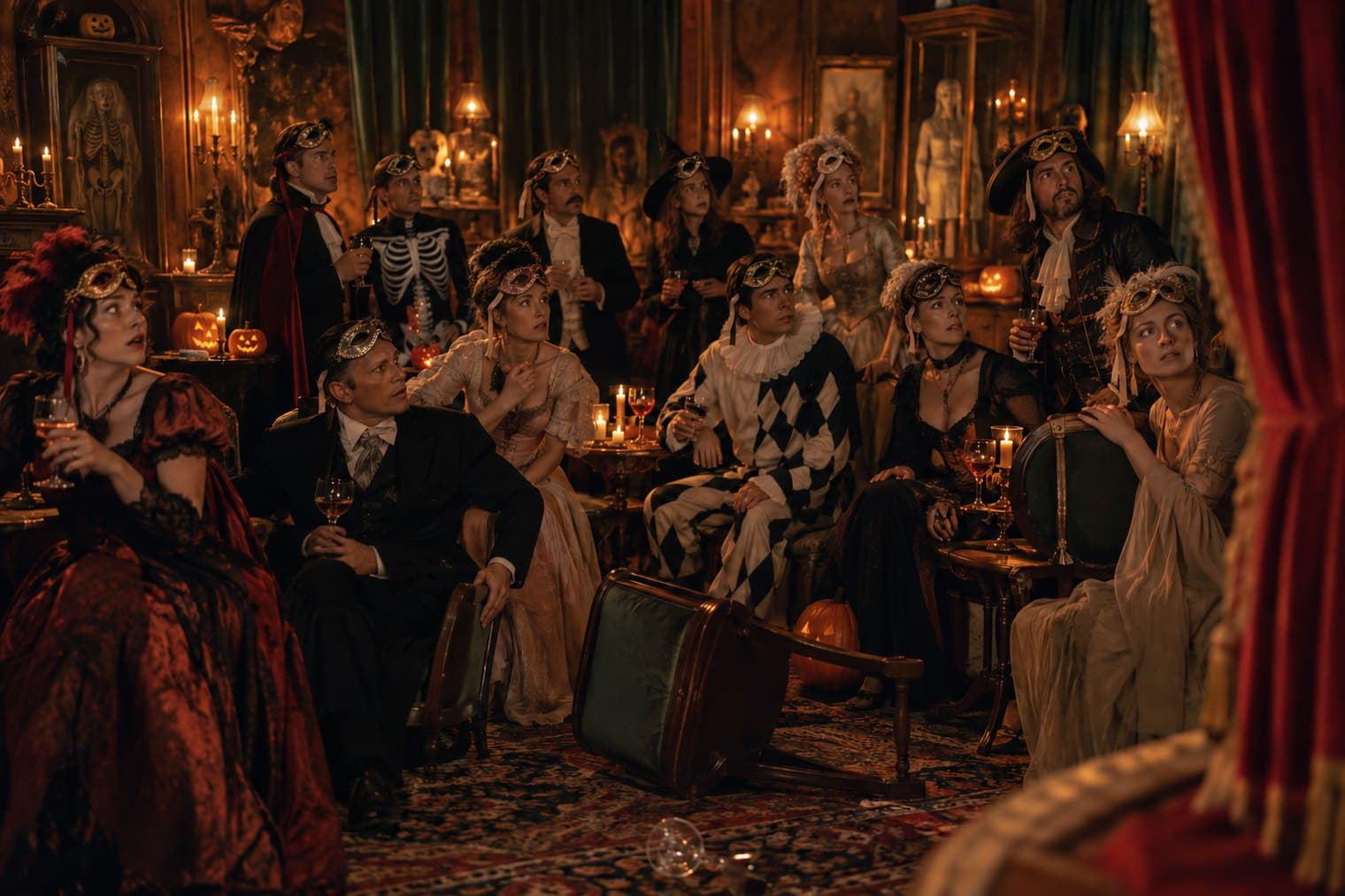
The Masked Ball is a good match for seven. It is set in Venice in 1520, in the middle of Carnival, and runs 2 to 2.5 hours. The host plays the majordomo, the non-player character who runs the household, which gives the host a natural reason to move between groups and to answer for the guest who is present in the story but not at the table.
Masks solve the costume question for a group that will not dress up: one mask each, bought or cut from card, and the room is in period. They also make the floating-suspect effect stronger, since a masked stranger walking into a conversation is exactly what the setting expects.
At seven, The Masked Ball sits toward the shorter end of its 2 to 2.5 hours. Plan for 7:30 pm arrivals, the introduction at 8:00 pm, three rounds with food between the first two, and the ballot around 10:00 pm. The other kits work as well at seven; this one simply gives the host and the odd number something to do.
When an eighth guest turns up, or the seventh drops out
The eighth sheet already exists in your file. If a guest brings a partner or a late yes arrives on the day, print the second added role, hand it out, and the game runs as the guide describes at eight with nothing else to change. If your guest list has any doubt in it, print that sheet from the start and keep it in an envelope; it costs one sheet of paper.
If the seventh guest cancels, you are back to six, which is the core cast exactly. If the missing guest held the added role, it returns to the story as a guest and you prepare the one-line answer for it. If the missing guest held one of the core six, move the player holding the added role onto that core sheet, because the core six are always handed out, and return the added role to the story instead. Either way the solution is unchanged. What to do when a guest cancels at the last minute covers the triage in detail.
Seven, in other words, is the count with the most room on both sides. A printable murder mystery for 6 players explains the floor of the tier, and a printable murder mystery for 8 players shows the full cast of the tier in play.
Frequently asked questions
Do I need an even number of players for a murder mystery kit?+
No. The kits play at any count from 6 to 12, odd or even. The host guide lists a core cast of six roles that are always handed out and names the roles that join at eight, ten and twelve. At seven you hand out the core six plus one of the two roles that join at eight.
Which tier do I buy for 7 players and what does it cost?+
The 6 to 8 player tier at $39, which covers six, seven or eight players with one purchase. The PDF is built for that tier at checkout and emailed within seconds of payment by card. Nothing is shipped, and there is no separate seven-player file to look for.
What happens to the character I do not hand out?+
It stays in the story as a guest at the event. The character is still present in the setting, and if a clue mentions them the host answers briefly for them from what the guide says. The solution does not change and no player has to double up on roles.
Can the host be the seventh player?+
Yes, if you would otherwise be six. A host may take a suspect role that is not the culprit, since the host reads the solution. With six guests and a host playing a suspect, you hand out the core six plus one added role and run the game at seven as written.
What if an eighth guest shows up on the night?+
Print the second added role from the file you already have, hand it out, and run the game at eight as the guide describes. The 6 to 8 tier covers it with no extra purchase. If you have any doubt about your list, print that sheet in advance and keep it sealed in an envelope.