What a printable murder mystery for 12 players costs: the 11 to 12 tier
All seven kits are written for 6 to 12 players and sold in three tiers: $39 for 6 to 8, $49 for 9 to 10, $59 for 11 to 12. Twelve is the top of the top tier, so $59 is the most a kit ever costs, and split twelve ways it is under $5 a head. One purchase covers the group; you choose the tier at checkout and the PDF is built for it.
The file arrives by email within seconds of paying by card. Nothing is shipped. It contains the host guide, twelve character sheets, the clues organized by round, twelve secret ballots and the solution. At twelve, every role in the file is handed out: the core six, the two that join at eight, the two that join at ten and the two that join at twelve. The host guide's section on adapting the game has nothing left to adapt.
The printable murder mystery kit page explains the download and the tiers.
Eleven players use the same file
Eleven buys the 11 to 12 tier at $59, and the host guide tells you what to do with the twelfth seat: hand out one of the two roles that join at twelve, and leave the other in the story as a guest. The murderer and the key witness are in the core six, so the solution is unchanged. If a clue mentions the absent character, the host answers briefly for them from what the guide says.
Choose the added role to hand out by your eleventh guest, not by the plot: read both sheets, and give out the one that suits the person. Print the twelfth sheet anyway and keep it in an envelope. At this size a plus-one on the doorstep is not rare, and the sheet already exists in your file.
Everything else in this article applies at eleven exactly as at twelve.
Two rooms or an open plan
Twelve players in one dining room is not a party, it is a queue. Each player has eleven people to question, and they cannot do it shoulder to shoulder around one table. Give the game two rooms with an open door between them, or one open-plan space large enough for three zones of four. The table stays the anchor for the introduction, the clues and the ballot; the rounds happen everywhere else.
Walk the space before the night with the guest count in mind. Twelve players and a host and a co-host is fourteen adults; a living room that feels big empty feels small at fourteen. Clear surfaces, push the sofa back, and mark the zones with lamps so that people move toward light.
If you have a house, use two floors: one room downstairs, one up, and the stairs as the corridor where the crossing conversations happen. The host and the co-host each take a room during the rounds and swap at the halfway mark.
A co-host is no longer optional
At twelve, one person cannot narrate, play the non-player characters, hand out three rounds of clues, keep fourteen people to a clock and cover two rooms. Recruit a co-host before you print. The division of labor is simple: the host owns the story, reading the introduction, the bridges between rounds and the solution, and plays the non-player character the scenario gives the host. The co-host owns the room: envelopes, clue piles, the timer, drinks, moving groups between zones.
The co-host does not read the solution. That keeps one of the two organizers free to be questioned honestly, and it means the co-host can take a character like any other guest if the count needs it. The host, who has read the solution, may only ever take a suspect who is not the culprit.
Brief the co-host the day before with the printed host guide on the table: the run of the rounds, the clue schedule, the end time, the room plan. Half an hour is enough.
Longer rounds and a later reveal
Rounds grow with the cast. At eight a round is about thirty-five minutes; at twelve plan forty-five, sometimes fifty, because each player is working through eleven conversations and the room takes longer to cross. Three rounds at that length, with the introduction, the clue breaks and the ballot, is close to three hours of play on a scenario announced at 2 to 2.5 hours.
A clock that works at twelve: arrivals at 7:00 pm, introduction at 7:30 pm, round one until 8:20 pm, a buffet break until 8:50 pm, round two until 9:40 pm, dessert, round three until 10:25 pm, ballots collected by the co-host, reveal at 10:40 pm. Food between rounds, never during; at twelve a seated meal costs you a full round.
The ballot takes longer too. Twelve accusations read aloud is ten minutes, and it is ten minutes worth having: let each player name their suspect and give one sentence of reason before the host reads the solution.
Printing volume at twelve: when a print shop helps
Twelve players is the first count where printing at home becomes a real job. The host guide, twelve character sheets of one or two pages each, three rounds of clues, twelve ballots and the solution add up to a stack that a slow home printer takes the better part of an hour to produce, with a color evidence page or two on top.
A print shop is a reasonable alternative at this size. Send the PDF as it is, ask for black and white on standard paper for the sheets and color for the clue pages that are photographs or documents, and ask for the pages collated in file order so you can sort into envelopes at home. The file is laid out on A4; on US Letter, ask for fit to page, which shrinks the page by about six percent with nothing cut.
Either way, sort into twelve named envelopes plus three clue folders, one per round, and hand the folders to the co-host. Printing a murder mystery kit at a print shop has the details on what to ask for.
Name tags become necessary at twelve
At six everyone remembers who is who after the introduction. At twelve nobody does, and a player who cannot remember which character the person in front of them is playing cannot use the clue that names them. Name tags are the fix, and they are not in the kit: the PDF contains the host guide, character sheets, clues, ballots and the solution, and no name tags, place cards, invitations or decorations.
Make them yourself in twenty minutes. Character name large, the player's real first name small underneath for the first half hour, and one word for what they are in the story if the sheet gives you one. Pin or lanyard; stickers peel off a jacket by round two.
Name tags and place cards for a murder mystery goes through layouts and what to print them on.
Crime Aboard the Orient Express and The Masked Ball with a full cast
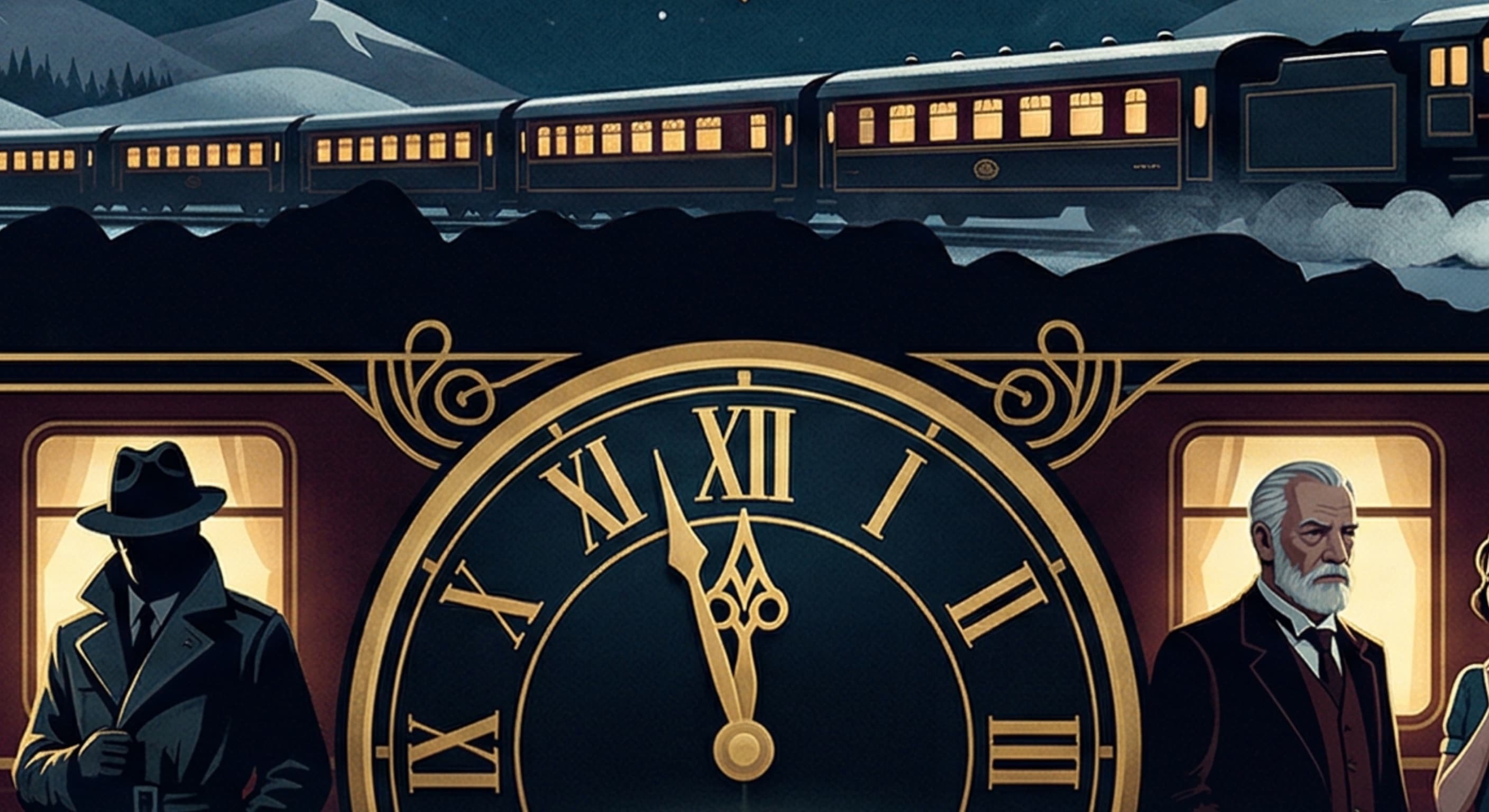
Two kits carry twelve especially well. Crime Aboard the Orient Express is a locked-room murder on a luxury night train, 2 to 2.5 hours, and the host plays the train inspector, a non-player character with a reason to walk every carriage and question anyone. A closed setting suits a big cast: nobody could have left, so all twelve are suspects from the first minute, and two rooms become two carriages without a word of explanation.
The Masked Ball, Venice in 1520 in the middle of Carnival, 2 to 2.5 hours, gives the host the majordomo and gives the twelve players masks, which are the easiest costume in the catalog and make a crowd look like a ball rather than a living room.
Beyond twelve, no kit goes. Thirteen or more is either a custom scenario written around your group, or two tables running two kits with a shared reveal; murder mystery for 15 players: printable options compares the routes. For the tier below, a printable murder mystery for 10 players explains the 9 to 10 file.
Frequently asked questions
How much does a printable murder mystery for 12 players cost?+
$59, the 11 to 12 player tier, which is the top tier and the most a kit ever costs. Split twelve ways it is under $5 a head. One purchase covers the whole group, and the PDF is built for the tier at checkout and emailed within seconds of paying by card.
Can 11 players use the 12-player file?+
Yes. Eleven buys the same 11 to 12 tier. The host guide tells you to hand out one of the two roles that join at twelve and leave the other in the story as a guest; the host answers briefly for that character if a clue mentions them. The solution is unchanged.
Can a kit be played with 13 or 14 players?+
No. Every kit is written for 6 to 12 players and the top tier is built for twelve character sheets. Above twelve the options are a custom scenario written around your group, up to 15 or 25 players, or two tables running two different kits with two hosts and a shared reveal.
Do I need two rooms for 12 players?+
Two rooms with an open door, or one open-plan space with three zones, is strongly recommended. Twelve players around one table cannot get through eleven conversations each in a round. Keep the table as the anchor for the introduction, the clues and the ballot, and let the rounds spread out.
How long does a murder mystery party take with 12 players?+
Close to three hours of play for a scenario announced at 2 to 2.5 hours, because rounds run forty-five to fifty minutes at this size, plus arrivals, a food break between rounds and a ten-minute ballot. Put the real end time on the invitation so nobody leaves before the reveal.
Does the kit include name tags for 12 players?+
No. The PDF contains the host guide, the character sheets, the clues by round, the ballots and the solution. Name tags, place cards, invitations and decorations are not included. At twelve, name tags are worth making yourself: character name large, the player's first name small underneath.