The part the host guide already gives you
Every kit is written on the assumption that the host is in the story. The guide gives you the introduction to read aloud, which sets the scene and announces the crime, and the short passages that bridge one round to the next. Reading them is the narrator's job, and it takes a few minutes per round.
The guide also gives you the non-player characters: the people who exist in the scenario but are not played by a guest. At the Masked Ball that is the majordomo of the palazzo. At the Royal Casino it is the casino manager. Aboard the Orient Express it is the train inspector. When a clue mentions one of them, or when a player wants to ask them something, you answer briefly in their place. It is a real part, and it can carry new information into the room at the moment the story calls for it.
So the host is never a referee standing outside the game. You are the voice of the setting. If that is enough of a role for you, stop here and run the printable murder mystery kit as written.
How a murder mystery host also plays a suspect without spoiling the game
Take a suspect role that is not the culprit. That is the one rule, and the reason is simple: you have read the solution, so you cannot investigate on equal footing with your guests. What you can do is be investigated. A host holding a character sheet answers questions like everyone else, reveals what the sheet says round by round, and keeps their own secrets. You just do not build a case, and you do not vote.
Three habits make it work. Play the role straight from the sheet and let the sheet decide what you reveal, so that your knowledge of the answer never colors how you play. Keep your theories to yourself, even when a guest asks you directly what you think; answer in character, not as the host. And when the ballots go around, pass. Your ballot would be a spoiler in an envelope.
The second role also has a cost. You are already reading passages, handing out clues by round and watching the clock. Playing a suspect on top is comfortable at six or seven players and gets heavy at ten or twelve. The sections below cover how to lighten that load, and how to be a good murder mystery host covers the habits that make the double role possible.
Playing the majordomo at the Masked Ball
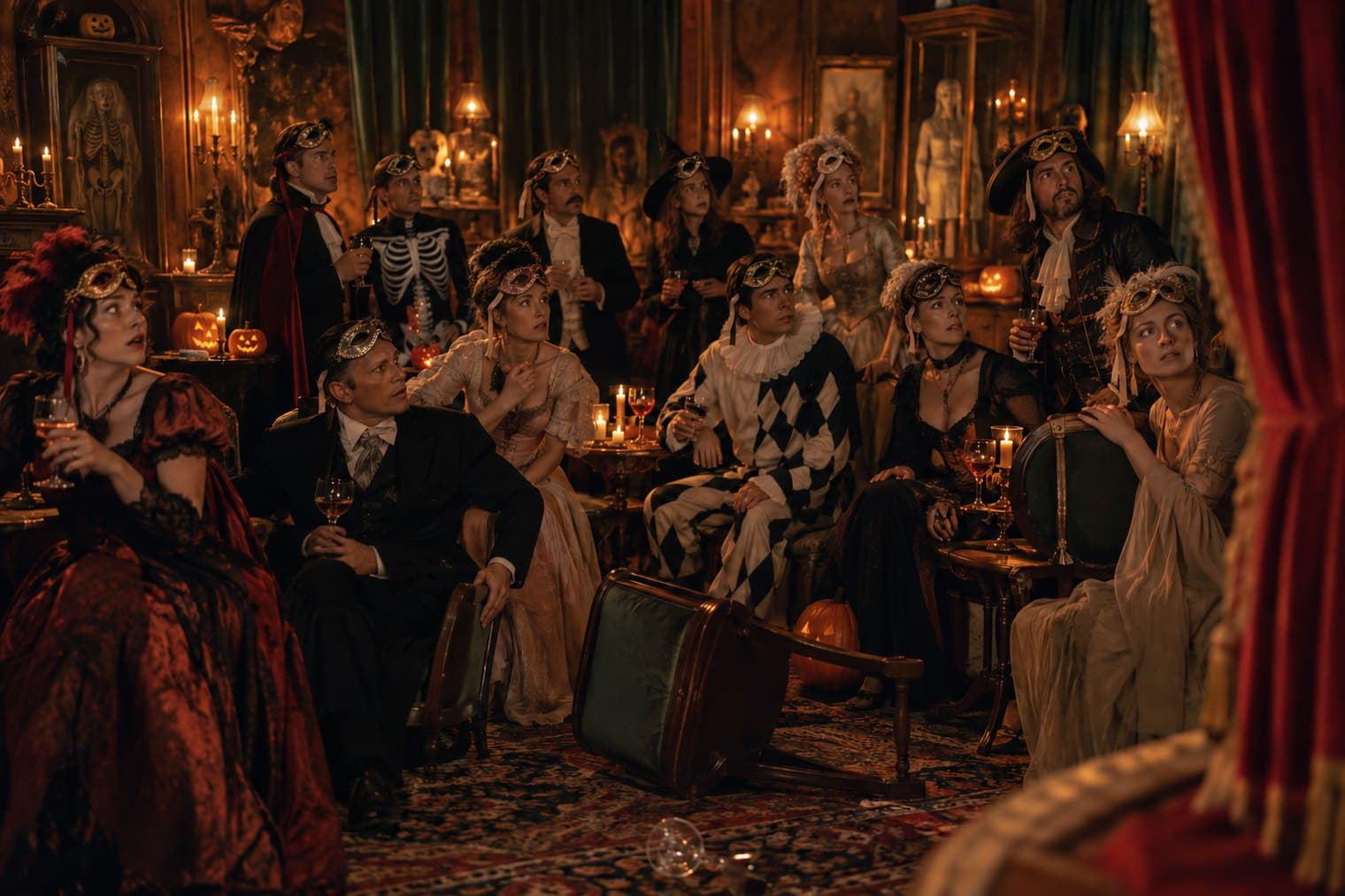
A worked example. The Masked Ball is set in Venice in 1520, at the height of Carnival, in a palazzo where a guest collapses in the middle of the celebration. It runs 2 to 2.5 hours and plays with 6 to 12 guests. The host's non-player character is the majordomo, the head of the household.
As narrator, you read the introduction that opens the evening. As the majordomo, you are the household's voice: when a clue mentions the staff, the rooms or the running of the evening, you answer for it, briefly and in character, with what the guide gives you and nothing more. When a round ends, the majordomo can be the one who announces it, and the next envelope of clues goes out.
If you also want a suspect role at the Masked Ball, take one that is not the culprit and play it between your majordomo duties. Most hosts find that the majordomo alone is plenty at this table size. Behind every mask in the room there is a motive, and keeping the clues flowing to a dozen masked guests is a full evening's work on its own.
A co-host for large groups of ten to twelve
At eleven or twelve players, one person reading passages, handing out clues to a dozen guests, voicing the non-player characters and watching the clock is stretched thin. A co-host fixes that, and nothing in the kit needs to change: print the host guide twice and split the jobs.
A split that works: one host owns the clock and the paper, meaning the round timer, the clue envelopes and the ballots. The other owns the voice, meaning the introduction, the bridging passages and the non-player characters. Both read the solution beforehand, so neither can take the culprit's role, and neither votes. If one of them wants a suspect role, it should be the voice host, since the paper host is the one moving around the room during rounds.
A co-host also solves the problem of the host who wants to play but cannot leave the clock. Hand the timekeeping to a friend who has read the guide and enjoys running things, take a non-culprit suspect role, and keep the narrator's passages for yourself. Two people who have each read the guide once are more than enough for the biggest tier.
No host at all: the detective case files
Some evenings have nobody willing to host, or a buyer who refuses to sit out the mystery. For those, the format changes rather than the workaround. A detective case file is a cooperative investigation for 2 to 6 players at $39: no roles, no host, no solution to guard. The whole group reads the same documents, cross-checks the same timelines and works together toward one answer.
Hints are included in the file, so the group can unstick itself without anyone knowing the answer in advance. The solution is sealed and stays sealed until the group decides to check its conclusion. Run times are 1.5 to 2 hours depending on the case, and difficulty is rated out of five, from 3 for The Heist of the Century or Vanished in Paris to 5 for Operation Blackout.
The trade is real. A case file gives you deduction without performance, and it gives the person who bought the game a seat at the table. It does not give you characters, secrets or an accusation. If your group is five people and nobody wants to host, that is the natural choice; the detective case files page lists all seven.
Five guests and a host who plays: reaching the core cast of six
Kits play with 6 to 12 people, and the host guide always hands out a core cast of six roles. A group of five friends plus a host is therefore one sheet short, unless the host takes one. A host holding the sixth sheet, a suspect who is not the culprit, completes the core cast, and the table plays a full kit at $39.
It is the most demanding version of the double role, because there is nobody to share the clock with, so it suits a shorter scenario. The Cursed Manor and The Cursed Island are both rated at about 2 hours, which keeps the narrator's duties and the suspect's duties from colliding for too long. It also suits a host who has run a kit before and knows where the bridging passages fall.
The alternative at five is the case file, where the host problem disappears entirely. The two options are compared in detail, with run times and what each evening feels like, in printable murder mystery for 5 players.
The timing burden, and how to lighten it
Whatever role you add, the clock is still yours. Three rounds of roughly thirty to forty minutes each, a bridging passage between them, ballots after the third, then the solution. Playing a suspect does not shorten any of it, so the goal is to make the timekeeping nearly automatic.
Before the night: read the guide once from start to finish, sort the clues into three envelopes labeled by round, and put the ballots and pens in a bowl. Send character sheets out days ahead so nobody is reading at the table. On the night: set a visible timer for each round so you are not the one announcing time, serve food between rounds and not during them, and keep the guide open at the bridging passage you will read next.
With that done, the host's own suspect role takes care of itself. You answer questions when asked, reveal what your sheet says, and step out of character for three minutes at each round break. If the load still feels heavy, drop the suspect role and keep the majordomo. The narrator and the non-player characters are the part the printable murder mystery kit was written to give you.
Frequently asked questions
Can the host play a character in a murder mystery party?+
Yes. The host guide already casts the host as narrator and as the non-player characters, such as the majordomo at the Masked Ball. A host who wants a suspect role too takes one that is not the culprit, since the host has read the solution, plays it from the sheet, and skips the ballot.
Can the host be the murderer?+
No. The host reads the solution and runs the reveal, so the rule is to take a suspect role that is not the culprit. The culprit's sheet goes to a guest who knows nothing beyond their own part of the story, which is what keeps the accusation fair for everyone else.
Does the host have to act?+
Not in the theatrical sense. The narrator's passages are read from the guide, and the non-player characters are answered briefly when a clue mentions them, seated, in your own voice. A host who never puts on an accent runs the game just as well as one who does.
Can two people host a murder mystery kit together?+
Yes. Print the host guide twice and split the work: one person keeps the timer, the clue envelopes and the ballots, the other reads the passages and voices the non-player characters. Both read the solution beforehand, so neither takes the culprit's role and neither votes.
Is there a murder mystery format with no host at all?+
The detective case files. They are cooperative investigations for 2 to 6 players at $39, with hints included and a sealed solution, so nobody has to sit out or know the answer in advance. Everyone investigates the same documents together and reaches the conclusion at the same time.