Wind: clipboards, page sleeves and a stone on the clue pile
Paper is the whole game, and a garden moves paper. Give every player a clipboard: it holds the character sheet, the ballot and a page of notes, and it survives being carried around a lawn for two hours by someone holding a drink in the other hand. Cheap clipboards, one per player, are the best money you will spend on the party after the kit itself.
Clues get passed from hand to hand, so slide each one into a page sleeve before the party and hand out the sleeve. The host's clue pile, sorted by round in three envelopes, sits on the clue table under a stone, and the host guide stays in a folder that closes. A breeze under a table sends twelve ballots across the grass at the exact moment they matter, so the ballots are written on the clipboards and collected by hand.
Print one spare set of clues. Outdoors, one page will end up in the pond or under a chair leg, and a spare set means the round continues. The kit prints as many times as you like at home, so a second copy of the clue pages costs paper and nothing else.
Light: finish the ballot before dusk or plan lanterns
A kit is read, not just spoken, so the game needs reading light until the last ballot is written. Look up the sunset time for the date and work backward: with a 2 hour kit, the introduction must be read at least 2 hours 30 minutes before dusk if the ballots are to be written in daylight, which in midsummer is easy and in October means a 4:00 pm start.
If the evening runs past sunset on purpose, plan the light rather than hoping. Lanterns or string lights over the clue table, so the evidence stays readable, and one bright lamp where the host stands to read the solution. Players can question each other in half-light; they cannot read a clue in it. A headlamp for the host sounds ridiculous and works.
The transition is the moment to watch. Dusk arrives during round three more often than hosts expect, so if the light is going, collect the ballots early rather than playing the last ten minutes with nobody able to read their notes. A reveal read by lantern light is a good ending; a ballot written in the dark is a guess.
Sound: spread-out zones help an outdoor murder mystery party
Indoors, twelve players in one room is noise, and the host spends the evening asking people to talk more quietly. Outdoors the problem reverses. Conversations spread out on their own, the terrace, the lawn, the bench under the tree, and each cluster can hear itself. Define three zones before guests arrive and put a chair or two in each.
The cost of space is the host's voice. It does not carry across a lawn, so gather everyone to one spot for the four moments that need the whole cast: the introduction, the start of each round, and the reveal. A bell, a glass tapped with a spoon, anything that cuts through, and a fixed gathering point that everyone knows from the start.
The clue table is the other fixed point. Players come to it; it does not move. Put it where the host can see the whole garden, under cover if there is any, and keep the round's clues on it rather than in the host's hands, so a player who wants to re-read a document knows where to find it. The printable murder mystery kit page describes how the clues are organized by round, which is what makes a fixed table work.
Plan B: the indoor fallback you decide on by noon
The kit does not care where it is played, so the fallback costs nothing except a decision. Clear an indoor table and a corner for the introduction the day before, as if the party were indoors, and then check the forecast at noon on the day and decide once. A party that starts outside and moves inside during round two loses twenty minutes and half its momentum, so the rule is to choose before guests arrive and not to revisit it.
If rain arrives anyway, finish the current round outside under whatever cover exists, then move at the break. The rounds transfer cleanly because everything a round needs travels with the host: the envelope of clues for the next round, the ballots, the host guide. Players carry their own clipboards. Name the room, and start the next round inside as if nothing happened.
Heat and cold are also plan B questions. In full sun, wait until the sun is low or play in the shade, and put out water where people will see it. On a harvest evening, a fire pit and blankets on the chairs turn cold into atmosphere, which is the version The Last Vintage was made for.
Paper: print on heavier stock, in black and white if you like
Print the whole kit two days ahead, on the heaviest paper your home printer accepts. Ordinary paper wilts in humidity and in a hand that has been holding a cold glass, while heavier stock survives the afternoon and takes a pen on a clipboard without tearing. The PDF prints on any home printer and is laid out on A4; on US Letter paper tick fit to page in the print dialog and the page shrinks by about six percent with nothing cut.
Black and white is a good choice outdoors. Text pages print perfectly without color, the print costs less, and a document that lives in the sun for two hours looks the same at the end as at the start. The guide to printing a murder mystery kit in black and white covers which pages gain from color and which do not.
Nothing is shipped, so the printing is the only physical step. Sort the character sheets into envelopes marked with the character name, the clues into sleeves and then into three round envelopes, the ballots onto the clipboards, and the solution into the host's folder.
The Cursed Island for a summer afternoon, The Last Vintage for a harvest evening
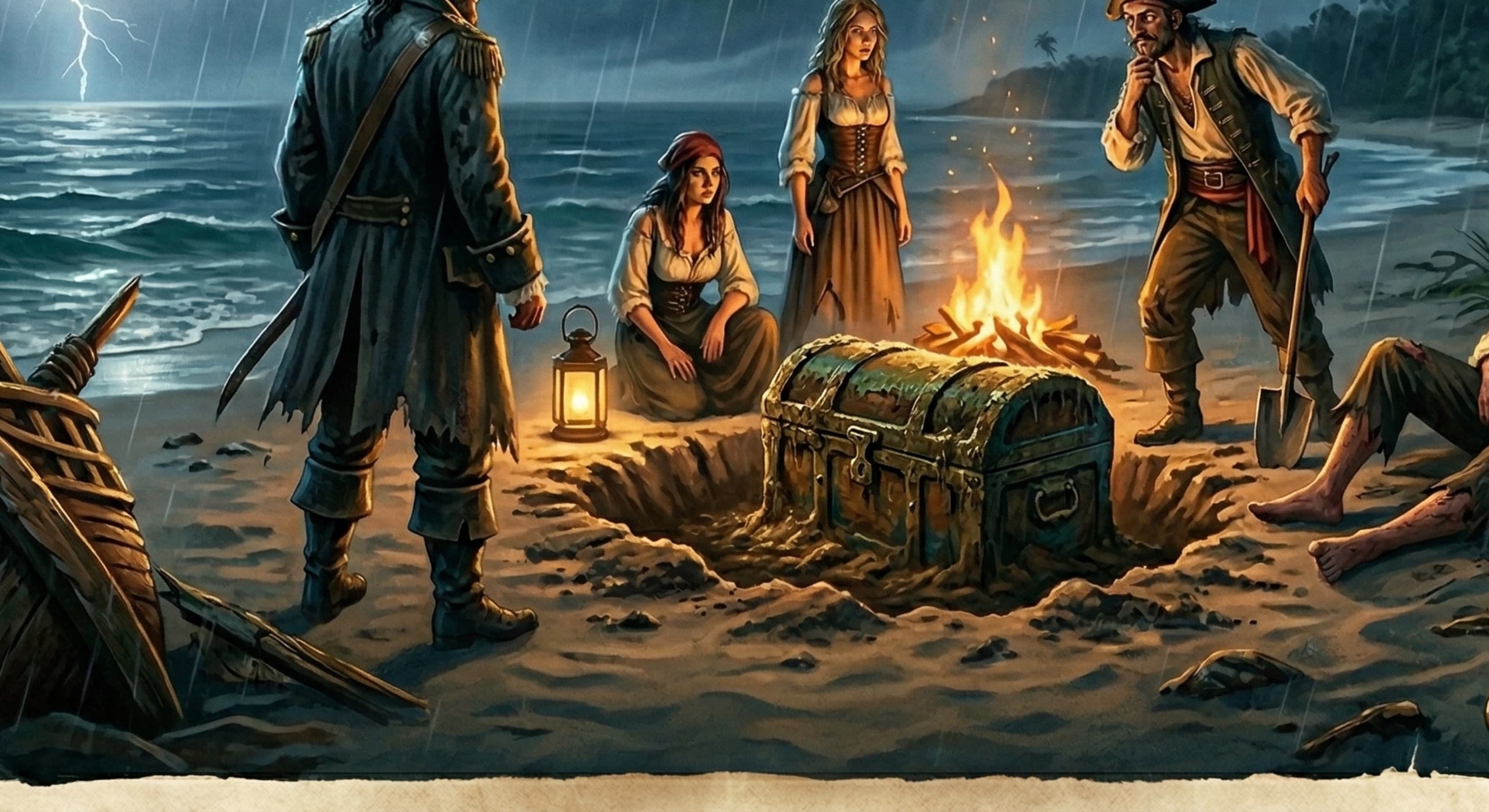
The Cursed Island was made for a lawn. Survivors of a shipwreck wash up on a forgotten island where a treasure is said to sleep, one of them does not wake up one morning, and a traitor hides among the crew. A garden in July is the island, a bandana is the costume, and the story runs about 2 hours, which fits a 4:00 pm start with the ballots in before dinner and the sun still up.
The Last Vintage is the harvest evening. A Saint-Emilion estate in October 1985, a party for the sixtieth vintage, and the master of the house collapsing among the barrels an hour after raising his glass. A garden in October with a fire pit, bottles on the table and a 4:30 pm start puts the ballots at dusk and the reveal by lantern. It runs 2 to 2.5 hours.
Both play with 6 to 12 players, sold by tier: $39 for 6 to 8, $49 for 9 to 10, $59 for 11 to 12. In the southern hemisphere the garden season flips to December, and the article on a printable murder mystery party in Australia is written for hosts there.
Timing around a barbecue
The grill and the game do not overlap. Whoever runs the grill cannot play a round. So the barbecue happens either before the introduction or between round one and round two, and never later. Here is the afternoon version for ten players and The Cursed Island.
2:30 pm, arrival, drinks, clipboards and envelopes handed out
3:00 pm, fifteen minutes of reading in the shade
3:15 pm, everyone gathered at the fixed spot, the host reads the introduction
3:20 pm, round one across the zones
3:55 pm, grill on, food served, clues for round two on the table
4:45 pm, round two
5:20 pm, clues for round three, a short break
5:30 pm, round three
6:00 pm, ballots written on the clipboards and collected, each accusation heard out loud
6:10 pm, the reveal at the gathering point, then dessert
The fifty-minute food gap between rounds one and two is long on purpose: a grill takes that long. If the host also cooks, hand the clue envelope for round two to a co-host before lighting the grill. The July version of this schedule, with fireworks as the deadline, is in the article on a murder mystery for a Fourth of July cookout.
Frequently asked questions
How many players can an outdoor murder mystery party take?+
The same as indoors: 6 to 12 players per kit, sold by tier at $39, $49 and $59. More lawn does not mean more roles. Above twelve, run two tables with two different kits and two hosts in two zones of the garden, or use the custom scenario written for up to 15 or 25 players.
What if it rains on the day?+
Decide at noon and once. Have an indoor table and a reading corner ready the day before, check the forecast at midday, and move the whole party inside if it looks wet. If rain arrives during a round, finish the round under cover and move at the break: the clues, ballots and host guide travel with the host, and players carry their clipboards.
Do we need a table outdoors?+
One table for the clues and the host, in a fixed spot everyone knows. Players do not need a table: each one carries a clipboard with the character sheet, a page of notes and the ballot, and the rounds are conversations spread across the garden. Chairs in two or three zones matter more than a second table.
Can we play after dark?+
Yes, with light over the clue table and a lamp where the host stands. Players can question each other in half-light but cannot read a clue or write a ballot in it. Lanterns or string lights over the table, a headlamp for the host, and the ballots collected before the light is gone.
Does the kit print on heavier paper?+
It prints on any home printer, in color or in black and white, on whatever paper the printer accepts, and heavier stock is the right choice for a garden because it survives humidity and handling. The PDF is laid out on A4; on US Letter, tick fit to page and the page shrinks by about six percent with nothing cut.