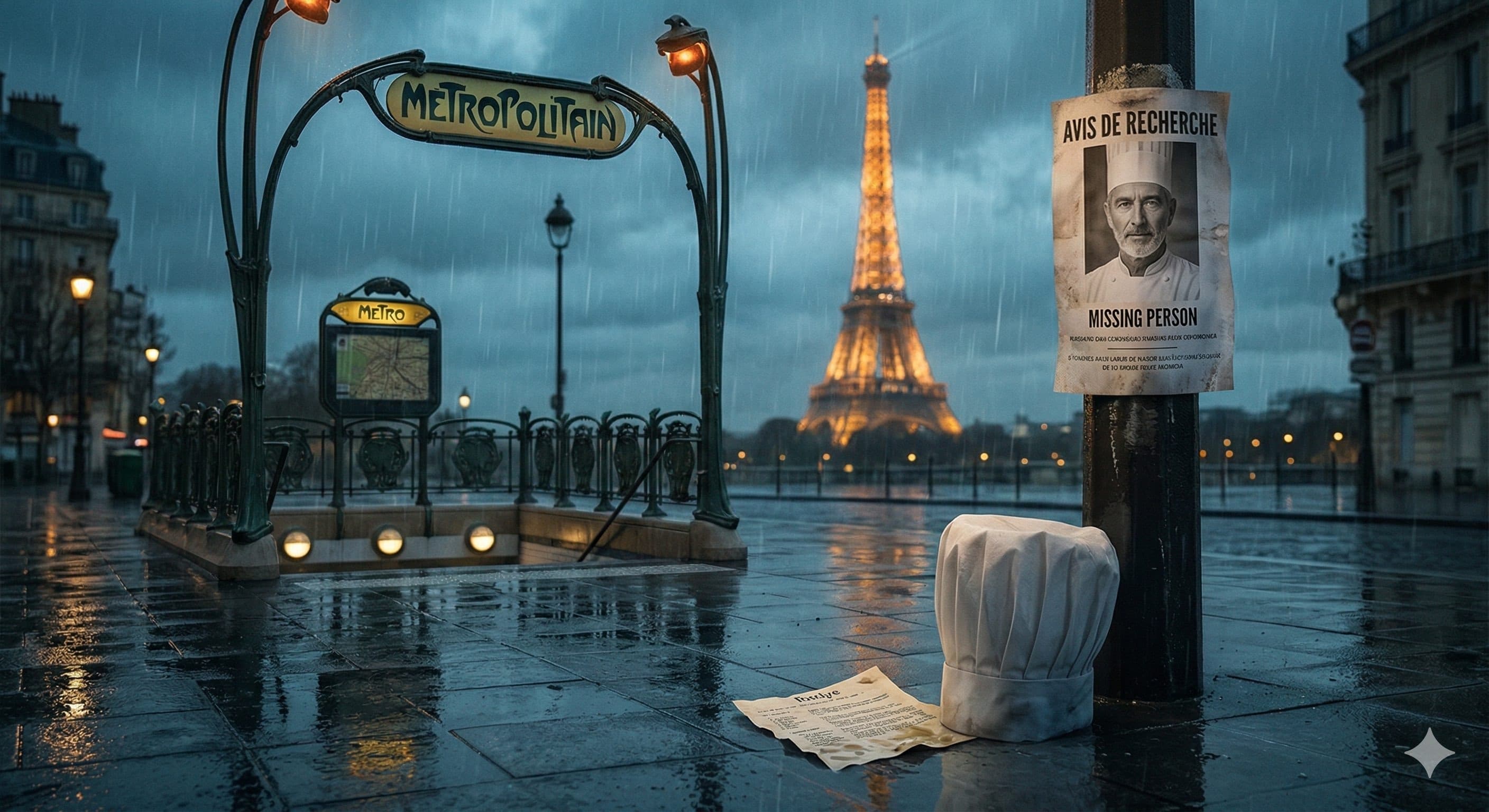
What is inside the Vanished in Paris PDF?
Thirty-one pages. The cover, the how-to page, the briefing, the inventory of the twenty-four exhibits, working sheets for times and people, a conclusions report, then the twenty-four exhibits photographed one per page. Everything is on the table from the start; there is no envelope to open later and nothing to seal.
What is not in the PDF: the four levels of hints and the solution, which live on the case file portal behind your personal code. The product page, with five real pages as excerpts, is Vanished in Paris.
How can a detective case have no cipher and still be rated 5?
Because the difficulty is the volume and the cross-checking. Twenty-four documents describe the same days from sources that did not copy one another: a schedule, statements, receipts, messages. None of them is false on its own, and none of them is enough on its own. The work is to build one timeline, to spot which claim is contradicted by which document, and to distinguish what a paper proves from what it merely suggests.
That is harder than a puzzle for many groups, because there is no moment where a key falls into place. It rewards patient readers and people who take notes. It punishes nobody for not liking math.
How do you organise a session that lasts 3 to 4 hours?
Plan one sitting with a break, not two evenings: the timeline lives in the group's heads and fades overnight. A table wide enough for the twenty-four pages side by side, pencils, the working sheets printed once per person. Split the exhibits by type at the start, then swap after thirty minutes so everyone has read everything.
At one or two investigators, four hours is realistic. At six or seven, the reading goes faster but the discussion takes longer; three hours is common. The detective case files page gives the run time of each case so you can pick a shorter one if the evening is short.
When should the group open a hint?
When it has spent fifteen minutes without a new fact, not when it disagrees. The first hint level only reminds you where to look; the second names the exhibits to compare; the third reasons up to an intermediate conclusion; the fourth unblocks. Each is a voluntary click on the portal, and a group that wants the full four hours never has to use them.
Two questions follow: an intermediate one to confirm the thread, then the final one that opens the complete solution and a reconstruction table. After three wrong answers a safety exit opens the solution anyway.
Who is Vanished in Paris for?
Readers. A group that liked The Heist of the Century and wants something longer and denser; a couple who enjoy a whole afternoon on one case; friends who prefer arguing over documents to solving riddles. It is not the case to start with if nobody at the table has played a printable case before.
For six to twelve players with a host, the right format is a murder mystery kit, where every guest plays a suspect. For a group larger than twelve, the custom murder mystery.
Frequently asked questions
Is there any cipher or code to break in Vanished in Paris?+
No. The case is built entirely on cross-checking twenty-four documents: timelines, statements, receipts. No substitution table, no math. The difficulty comes from the volume and from telling proof apart from suggestion.
How long does Vanished in Paris take?+
Three to four hours in one sitting with a break. Solo or in pairs, closer to four; at six or seven investigators the reading is shared and three hours is common. It is one of the two longest cases in the catalogue.
Can we stop and resume the next day?+
You can, the file is yours, but the timeline you built together fades overnight. The portal code stays valid one week from its first opening, so a second sitting within the week is possible if you keep your working sheets.
How many players can join?+
One to seven investigators. There is no host, no character to play and no traitor at the table: everyone works on the same side against the case.