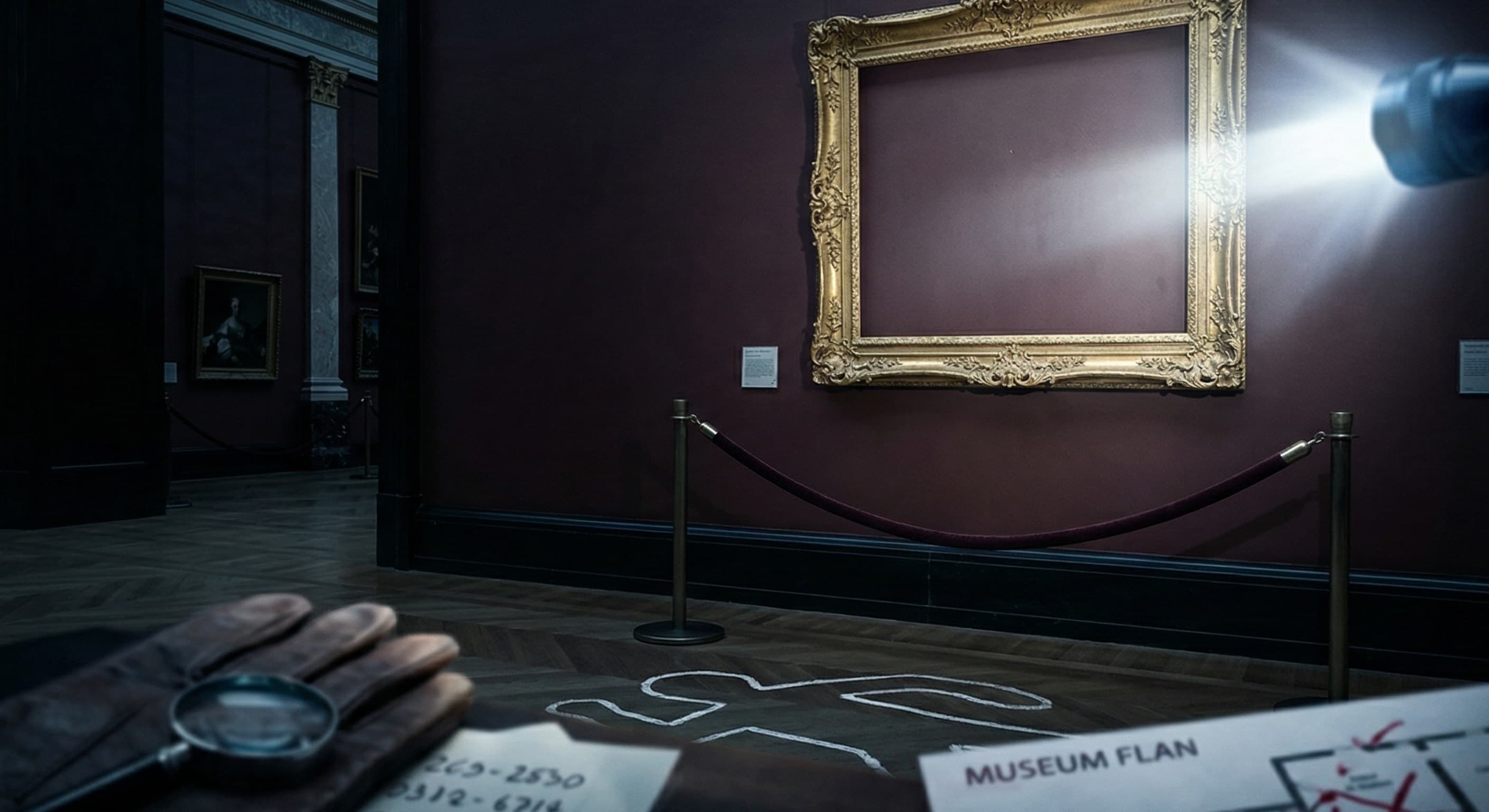
Where the clues live in the PDF, and the two channels of evidence
A kit PDF has a section called Clues to Hand Out, and it is organized by round. Round one, round two, round three, each with the documents the host releases at that point: letters, receipts, telegrams, photographs, notes, whatever the setting calls for. The host guide's run of the rounds tells you when each set goes out.
That is one channel of evidence. The other is the character sheets. Each sheet tells its player what to reveal round by round, so information enters the room from two directions at once: from the paper the host hands out, and from the players as their sheets release the next fact. A clue on the table and an admission in a corner of the kitchen often point at the same thing from different angles.
Understanding the two channels is what makes a host calm. If the table seems short of evidence, the clues are not the only lever. A player who has not yet said what their sheet told them to reveal this round can be nudged with a question, and the round fills out without opening the next envelope early. How those documents are written to look real is covered in fake documents in printable mystery kits.
Murder mystery clues by round: what each round is for
Three rounds is the usual structure, and in practice each one has a job. Round one tends to establish the situation: who was where, who had a reason to be angry, which alibis are on the table. Its clues open questions rather than close them, and the field of suspects is wide on purpose.
Round two adds evidence that complicates the picture. An alibi from round one turns out to have a gap, a document contradicts what someone said, a relationship nobody mentioned comes to light. This is the round where the first accusations are made and most of them are wrong, which is fine, because the point is to make players commit to a theory they will have to revise.
Round three narrows the field. Its clues are the ones that, laid next to the earlier ones, make the solution reachable for a table that has been paying attention. Not obvious, but reachable. That is why the third envelope is the most protected object in the room: released early, it collapses the game; released on time, it turns two hours of conversation into a case. The ballots follow it, then the solution.
The bridge between rounds: a passage and an envelope
A round does not end by itself. The host ends it, and the host guide gives you the tool: a short bridging passage to read aloud. It takes a minute, it moves the story forward, and it tells the room that the next set of clues is coming. Read it from the guide, and do not improvise additions; the passage says what the scenario needs said at that moment and nothing more.
Then distribute the next envelope. If you have sorted the clues by round the evening before, this is a matter of opening one labeled envelope and handing out its contents according to the guide. If you have not, this is the moment the evening stalls while you sort paper. The half hour of sorting described in assembling a printable murder mystery kit is spent precisely so that the bridges take a minute instead of ten.
Use the bridge as a natural break. Guests refill drinks, the host serves the next course, players who have been cornered escape. Then the round begins, and the new clues start moving around the room.
Three ways to hand out a clue
The guide tells you when each clue goes out. How you put it into the room is a host's choice, and there are three good ways.
Give it to one character. Hand the document to the player the guide indicates, or to the player it concerns, and let them decide what to do with it. Some will show it around immediately; some will hide it. Both are good for the game.
Place it on the table. Put the document where anyone can pick it up, say that it has been found, and step back. This works for evidence that belongs to the scene rather than to a person, and it draws the quiet players in, because reading a document is easier than starting a conversation.
Read it to everyone. Stand, read the clue aloud, and put it down. Use this for the clue that every player needs at the same moment, and use it sparingly, because a clue read aloud is a clue nobody had to work for.
Mix the three across a round. A round where every clue is read aloud feels like a lecture. A round where every clue goes to one person can leave half the table waiting. Two given, one placed, one read is a rhythm that keeps everyone busy.
Pacing: thirty to forty minutes per round
A round runs thirty to forty minutes. Shorter, and the clues have not circulated; longer, and the table has asked every question it can think of and starts drifting. Set a visible timer at the start of each round so that the end is a fact rather than a host's decision, and give a five-minute warning before it rings.
Do not serve food during a round. Eating splits attention, and a player with a plate cannot corner a suspect. Serve between rounds, at the bridge, where it becomes a natural pause rather than a distraction. A full meal fits at the bridge between rounds one and two; dessert fits before the ballots.
Watch the middle of the round rather than the ends. The first ten minutes take care of themselves as new clues land, and the last five are driven by the warning. The middle is where a host earns their keep: walk a clue over to someone who has gone quiet, name two characters with unfinished business, or answer for a non-player character when a clue mentions them. The full schedule for an evening, act by act, is in murder mystery party timing by act.
A lost, torn or spilled-on clue: reprint it from the PDF
Clues get lost. A document goes into a pocket and leaves with a guest who stepped outside, a glass tips over a photograph, a player folds a letter into something unrecognizable. None of this is a crisis, because the clue is a page in a PDF you own.
Keep the file open on a laptop or phone in the kitchen during the party, and keep a spare printed set of the clues for the round in progress if your printer is slow. If a clue disappears mid-round, print it again, or read it aloud from the screen as a found document, and carry on. Nobody at the table needs to know the original went missing.
After the party the same principle applies. The file stays yours, laid out on A4 and printing on US Letter with fit to page ticked, in color or black and white. Reprinting the whole kit for another private group is allowed under the license, as many times as you like. The clue envelopes are the part most worth reprinting fresh each time, because they are the pages that get handled, folded and, eventually, spilled on.
Never release the third round early
Every host is tempted at least once. Round two runs long, the table is circling, and someone says just give us the next clues. Do not. The third round's evidence is what makes the solution reachable, and a table that receives it before the second round's questions have been asked skips the part of the game where theories are built and broken.
The symptoms of a stalled round two have fixes that do not touch the envelope. A pair of characters whose sheets give them a reason to talk can be pointed at each other. A player who has not yet revealed what their sheet told them to reveal can be asked a direct question by the host's non-player character. A clue already in the room can be placed on the table again if it vanished into a pocket. Any of these restarts the round in under a minute.
If the group is genuinely done, end round two on time, read the bridge, and open round three on schedule rather than early. The round will feel fast, and that is fine. What matters is that the last evidence lands in a room that has already argued about the earlier evidence, because that is what the ballot is for. Every scenario on the murder mystery kits page is built on that sequence, and the printable murder mystery kit page shows how the clue section fits with the rest of the file.
Frequently asked questions
How are the clues organized in a printable murder mystery kit?+
In a section called Clues to Hand Out, sorted by round. Three rounds is the usual structure. The host guide's run of the rounds says when each set is released, and the character sheets add a second channel of evidence, since each player is told what to reveal round by round.
How long should each round of a murder mystery party last?+
Thirty to forty minutes. Set a visible timer, give a five-minute warning, and end the round with the bridging passage from the host guide before handing out the next envelope. Serve food between rounds, not during them, so the break falls at the bridge.
What if a clue gets lost during the party?+
Print it again from the PDF, which stays yours, or read it aloud from a screen as a found document. Keep the file open on a laptop in the kitchen and, if your printer is slow, a spare set of the current round's clues. Nobody at the table needs to know.
Can the host hand out round three early if the group is stuck?+
No. The third round's clues are what make the solution reachable, and releasing them before the second round's questions have been asked collapses the game. Restart a stalled round by pointing two characters at each other or by asking a direct question through a non-player character instead.
Should clues be read aloud or handed to one player?+
Both, mixed within each round. Hand most clues to one character, place some on the table for anyone to pick up, and read aloud only the one clue every player needs at the same moment. A round where everything is read aloud feels like a lecture.